

Massage for Chemotherapy Side Effects: What to Know

Updated: 1 day ago
Could massage support comfort during chemotherapy without being mistaken for cancer treatment? Massage for chemotherapy side effects may have a place in supportive care, but its effects can vary and it does not replace oncology care. It’s understandable to want relief while also being careful about what’s appropriate and what the evidence shows.
This article explains where massage may fit, what research can and can’t tell us, and why the right approach depends on your symptoms, treatment and individual circumstances. A 2022 guideline from the Society for Integrative Oncology and the American Society of Clinical Oncology recommends massage for cancer-related pain, particularly in palliative or hospice care. That guidance doesn’t mean massage treats cancer or will relieve every chemotherapy side effect.
You’ll learn what to discuss with your treating team and massage therapist, and how individualised Oncology Massage can be tailored to your needs. At Body Therapist, Oncology Massage is tailored to individual conditions. Lee Carnegie is a qualified remedial massage therapist, a Dynamic Movement Therapist Level 1 and a personal trainer, with specific Manual Lymphatic Drainage training.
Table of Contents
Massage for chemotherapy side effects: what it may and may not do
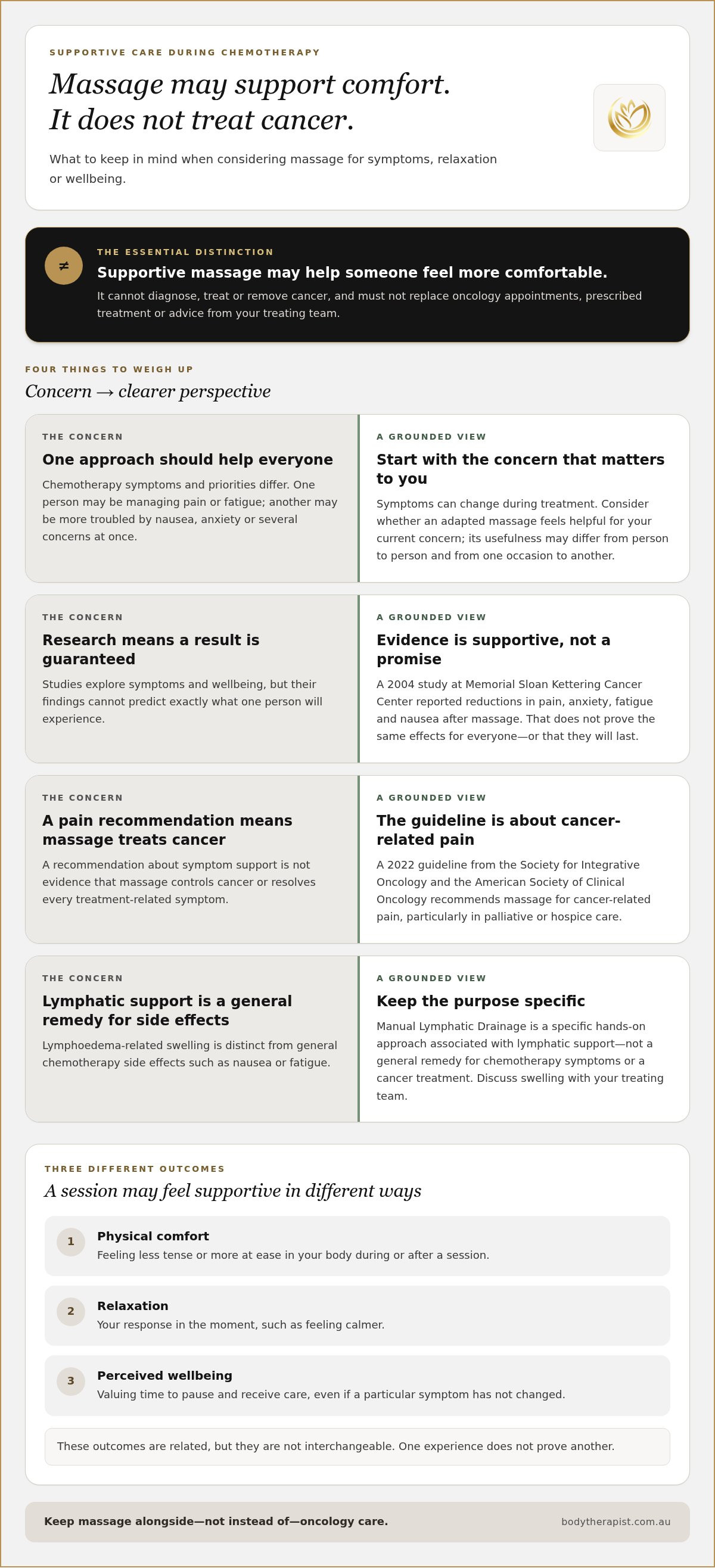
Massage may support comfort for some people during chemotherapy, but it does not treat cancer. Chemotherapy side effects vary: one person may be managing pain or fatigue, while another is more troubled by nausea, anxiety or several concerns at once. Symptoms can also change during treatment, so the usefulness of supportive care may differ from person to person.
Research and cancer-care resources have examined massage in relation to pain, fatigue and nausea. These are areas of interest, not guaranteed outcomes. A 2022 clinical practice guideline from the Society for Integrative Oncology and the American Society of Clinical Oncology recommends massage for cancer-related pain, particularly in palliative or hospice care. That recommendation concerns pain management. It isn’t evidence that massage controls cancer or resolves every treatment-related symptom.
Supportive massage may help someone feel more comfortable; cancer treatment is what is intended to control the disease. Keeping that distinction clear can help you consider massage realistically and discuss it alongside, rather than instead of, your oncology care.
Which chemotherapy-related symptoms has massage been studied for?
Pain, fatigue and nausea have been examined in massage research, but study results can’t predict what one person will experience. A 2004 study at Memorial Sloan Kettering Cancer Center reported reductions in symptoms including pain, anxiety, fatigue and nausea after massage. Those findings don’t prove that massage will produce the same effects for everyone or that any effects will last.
Anxiety has also been measured in research, but it should be understood as a possible supportive outcome, not a promised result. Research findings, personal reports and established cancer treatments answer different questions. Evidence that a symptom changed during a study doesn’t show that massage treats the underlying cancer or reliably improves sleep.
Why massage is complementary care, not cancer treatment
Massage is hands-on supportive care. It cannot diagnose, treat or remove cancer, and it must not replace oncology appointments, prescribed treatment or advice from your treating team. Its possible role is narrower: some people may value it as an additional way to seek comfort or relaxation while receiving cancer care. Whether it feels useful depends on the individual and their circumstances.
For a broader clinical perspective, the discussion of oncology massage benefits can help clarify how supportive massage differs from cancer-directed treatment. The distinction matters: massage may be considered alongside oncology care, never as a substitute for it. If you’re exploring massage for chemotherapy side effects, define a specific goal, such as seeking comfort with a symptom, and discuss the idea with your treating team.
How massage may support comfort during chemotherapy
Massage is hands-on supportive care. During chemotherapy, its potential value may lie in offering a comfortable, attentive space focused on how you feel at that time. It shouldn’t be described as changing how chemotherapy works or correcting a specific biological process. The practical question is whether an adapted massage feels helpful for your current concern, and whether that remains true for you over time.
Research has explored massage in relation to symptoms and wellbeing, but findings describe groups and study conditions, not a guaranteed response for an individual. The potential benefits of massage for chemotherapy side effects depend on the person. Set a realistic expectation: a session may feel supportive, but its effect, if any, can differ between people and from one occasion to another.
Potential symptom relief and individual variation
Chemotherapy can bring different symptoms and priorities for different people. You may be most concerned about physical discomfort, or you may want a quiet opportunity to relax. Symptoms can also shift during treatment, so the concern that matters today may not be the same later.
Massage may be considered for support with a particular concern, but it can’t promise to prevent, cure or relieve a symptom. A friend’s positive experience can tell you what massage felt like for them, but it can’t predict your response. Identify what you hope to get from care and keep the expectation specific: comfort or relaxation may be possible, not assured.
The role of lymphatic support in a separate context
Lymphoedema-related swelling is a distinct concern from general chemotherapy side effects such as nausea or fatigue. Manual Lymphatic Drainage is a specific hands-on approach associated with lymphatic support. It shouldn’t be presented as a general remedy for chemotherapy symptoms or as a treatment for cancer. If swelling is a concern, discuss it with your treating team so it can be considered in the context of your care.
Keeping the purpose clear helps match the approach to the concern. Someone seeking general comfort is asking a different question from someone seeking support for lymphatic swelling. Body Therapist offers Manual Lymphatic Drainage and tailors treatment to individual conditions. To explore personalised supportive care, learn about Body Therapist’s Oncology Massage and consider whether it aligns with your needs.
What the evidence says and what massage cannot promise
Evidence about massage in cancer care needs careful reading. A study may explore whether participants report a change in a symptom, while an individual may describe how a session felt. Neither, on its own, establishes massage as a proven treatment for cancer or guarantees the same result for someone else. This distinction matters when weighing claims about massage for chemotherapy side effects.
The table separates possible supportive outcomes from claims that go beyond what massage can do:
“May support” signals a possibility, not a prediction. One person’s reported experience describes their response, but doesn’t establish what another person will experience. A research finding reflects the participants and conditions studied; it shouldn’t be turned into a promise for everyone receiving chemotherapy.
How to read claims about massage and cancer care
Cancer Council WA and Breastcancer.org are among the sources represented in current search results discussing massage and cancer care. Their material can help readers understand the topic, but broad descriptions of potential benefits still need careful interpretation. Look for qualified language such as “may” and “some people”, and distinguish symptom support from evidence that a therapy treats the cancer itself.
For example, a statement that massage has been studied for nausea means researchers have examined that question. It doesn’t prove that massage will prevent nausea or work as well as a prescribed treatment. Likewise, someone describing a helpful session is sharing an experience, not establishing a predictable clinical effect.
What massage cannot do
Massage is not a cancer treatment. It cannot prevent, remove or reverse cancer, and it shouldn’t be relied on to prevent or reverse chemotherapy side effects. Oncology treatment and supportive care have different purposes: cancer-directed care aims to manage the disease, while supportive care may help address comfort and wellbeing.
That boundary supports informed decision-making. Don’t use massage instead of chemotherapy or other recommended oncology care, and don’t interpret a possible supportive benefit as evidence that cancer treatment can be changed. Discuss questions about treatment decisions or symptoms with your treating team.
How to consider massage during chemotherapy
A practical way to explore massage during chemotherapy is to start with your concern, discuss it with your treating team, then have a clear conversation with the massage therapist. This keeps the focus on your current circumstances rather than assuming one approach suits everyone. Begin by describing what you’re experiencing and what kind of support you hope to explore.
Identify your main concern. Be specific. Is your priority physical comfort, a chance to relax, or support with a symptom that’s affecting daily life?
Discuss massage with your treating team. Ask whether it fits your current care plan and circumstances, and how to coordinate it with ongoing cancer treatment.
Describe your situation to the therapist. Share relevant treatment context, your current symptoms and what you’d like the session to focus on.
This conversation helps you make an informed, individual decision. It isn’t a request for massage to replace medical care or a promise that symptoms will change. Your needs may shift, so update the therapist if your circumstances or priorities are different from the last time you spoke.
Questions to raise with your oncology team
Keep the discussion direct and centred on your situation. Ask whether massage fits alongside your current care, whether your specific symptom or concern changes that discussion, and how complementary care can be coordinated with treatment. If you’re unsure how to raise it, explain what you hope massage might offer and ask for your team’s perspective.
Does massage fit with my current care plan and treatment circumstances?
Is there anything about the symptom I’m concerned about that should guide this decision?
How can I coordinate complementary care with my ongoing cancer treatment?
These questions help clarify the role you’re considering for massage. Your oncology team can advise in the context of your care. The massage therapist can then use the information you choose to share to understand your needs.
What to communicate before a massage session
Before a session, tell the therapist that you’re receiving chemotherapy and describe relevant treatment context, current symptoms and personal priorities. You might explain that fatigue is your main concern, that you’re looking for a calm and comfortable experience, or that a symptom has changed recently. Clear, honest information helps the therapist tailor the approach to your stated condition and needs.
You can also say what you’re uncertain about or what you’d prefer the therapist to understand. There’s no need to predict how you’ll respond. Individualised care begins with listening and a shared understanding of the goal, not with a guaranteed outcome or a fixed approach.
If you’re ready to explore a personalised supportive-care option, learn about Body Therapist’s Oncology Massage, tailored to individual conditions.
Considering Body Therapist’s Oncology Massage for personalised support
For people exploring massage alongside cancer care, Body Therapist offers Oncology Massage within its Pre- and Post-Surgical Management services. It is individualised supportive care, not a way to treat cancer. The focus is on understanding the person’s circumstances and tailoring care to their individual condition.
That distinction matters during chemotherapy, when treatment context, symptoms and priorities can all be personal. Rather than assuming a standard approach will suit everyone, individualised care starts with understanding what the person wants support with and what they choose to share about their situation.
Body Therapist’s stated experience and approach
Lee Carnegie is a qualified remedial massage therapist, a Dynamic Movement Therapist Level 1 and a personal trainer, with specific training in Manual Lymphatic Drainage. These are the qualifications and training stated for Lee; they should not be taken to imply an additional oncology credential. Body Therapist tailors treatment to individual conditions.
For someone considering massage during chemotherapy, relevant context may include their treatment, current symptoms and the kind of supportive care they’re seeking. Sharing those details helps inform an individualised discussion. For example, someone might explain that comfort is their priority or describe a concern they’d like the therapist to understand. The aim is to relate care to the person’s stated needs, without assuming a particular technique or outcome.
Oncology Massage remains complementary care. It doesn’t replace advice or treatment from an oncology team, and it can’t guarantee relief from treatment-related symptoms. Keeping those boundaries clear helps set realistic expectations while allowing the person to consider whether massage aligns with their preferences and care context.
A practical next step for supportive care
If you’re considering massage for chemotherapy side effects, first identify what you’d like support with and discuss massage with your treating team. If you then explore Oncology Massage, sharing your treatment context and current concerns can make the conversation more relevant to your individual circumstances. Take time to consider whether this kind of supportive care feels appropriate for you.
Body Therapist’s Oncology Massage is tailored to individual conditions. To learn more about it as a supportive-care option, Explore Oncology Massage with Body Therapist.
Choose a supportive next step that feels right for you
As you consider massage for chemotherapy side effects, think about what feeling supported would mean for you. Perhaps you want to make space for rest, feel more comfortable, or explore an option at your own pace. Naming that priority can make your next conversation more focused, without turning a possible benefit into an expectation.
Your preferences matter. Take time to decide whether massage belongs alongside your care, and revisit that decision if your needs change. If you’d like to explore a personalised supportive-care option, Explore Oncology Massage with Body Therapist.
There’s no single right choice for everyone. A thoughtful, individual decision is a good place to start.
Frequently Asked Questions
Can massage help with chemotherapy side effects?
Massage may help some people feel more comfortable, but there’s no guaranteed response. You might be considering massage for chemotherapy side effects because muscle tension or feeling unsettled is affecting your day. Identify the specific change you hope for, such as feeling more at ease, rather than expecting massage to address every symptom. If you have a session, notice how you feel afterwards and share that with your treating team.
Is massage safe during chemotherapy?
Whether massage is appropriate during chemotherapy depends on your individual health and treatment circumstances, so there isn’t a blanket yes or no. Discuss it with your oncology team, especially if your symptoms or treatment situation have changed since you last considered massage. If your team supports exploring it, tell the therapist what’s relevant to your care so the discussion takes your current circumstances into account.
What type of massage is used for people with cancer?
Oncology Massage is the term commonly used for massage adapted for people affected by cancer and its treatment. It isn’t a cancer therapy. The approach should be discussed in relation to the person’s needs and treatment context, rather than assuming a standard remedial or deep tissue massage is suitable. If you’re exploring massage, explain that you’re receiving cancer care and what kind of supportive experience you’re seeking.
Can massage help chemotherapy-related nausea?
Massage has been studied in relation to nausea, but that doesn’t establish it as a reliable way to prevent or relieve chemotherapy-related nausea. If nausea is affecting eating, drinking or daily activities, tell your oncology team so they can advise you about symptom management. If you also consider massage, treat it as a possible supportive option, not a replacement for medical advice or care your team recommends.
Does massage treat cancer or remove chemotherapy drugs from the body?
No. Massage doesn’t treat cancer, remove it or “flush out” chemotherapy drugs. Claims that massage detoxifies the body or clears treatment medicines shouldn’t be taken as established effects. Chemotherapy is managed through your oncology care, and questions about medicines or how your body processes them belong with your treating team. Massage, if considered, has a separate supportive role and shouldn’t be used to alter or replace cancer treatment.
Should I speak with my oncology team before having a massage?
Yes. Discussing massage with your oncology team is a sensible first step during active treatment. Explain why you’re considering it, such as wanting support with a particular symptom or hoping for time to relax. Ask whether it fits your current care and how to coordinate it with treatment. Their advice can help you decide based on your circumstances, rather than general claims.
What should I tell a massage therapist before a session during cancer treatment?
Tell the therapist that you’re receiving cancer treatment, describe your current symptoms and explain what you’d like from the session. Include any changes that could affect how you’re feeling, and mention relevant guidance from your oncology team. For instance, you might say that fatigue is affecting your comfort or that you’d prefer a session focused on relaxation. Clear communication gives the therapist useful context to tailor care to your stated needs.


Comments